ZScorch
Add weight, colour, energy, and controlled aggression — without unnecessarily sacrificing clarity.
The problem
Clean signals can sound thin, flat, or lifeless. Adding saturation by hand is trial-and-error across EQs, drive stages, and parallel chains — and it is easy to muddy a mix.
The outcome
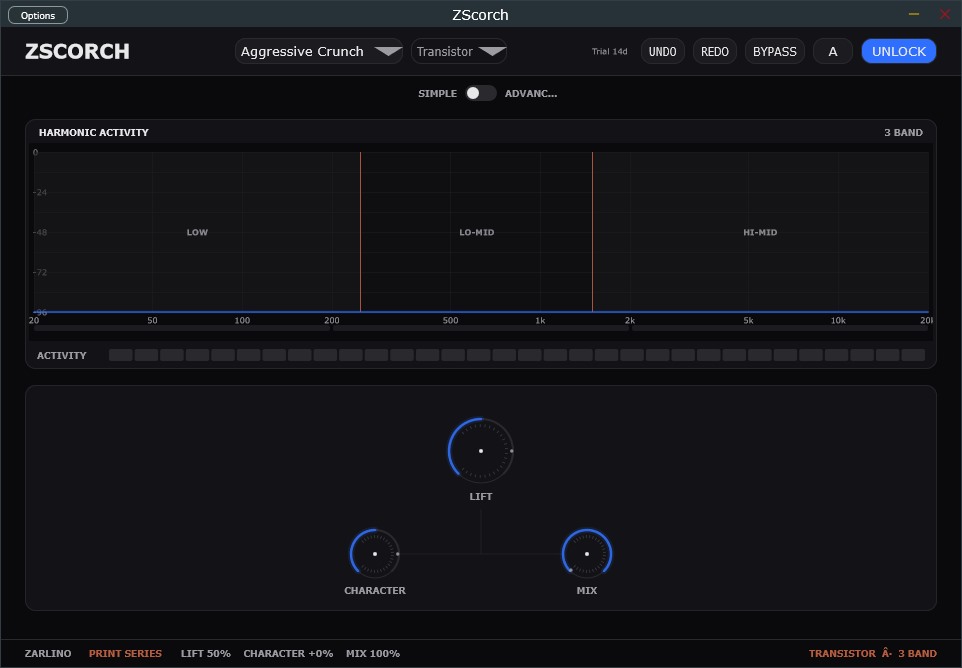
ZScorch adds controlled harmonic character — warmth, edge, and glue — through multiband saturation you can shape with a few simple macros.
Hear ZScorch — A/B
Real audio, before & after. Presets are disclosed — no hidden processing.
Choose a preset to audition
Guitar solo — "Seamless — Menagerie" (FL Studio demo project)
Disclosed preset — Tape Warm: Tape saturation, LR4 split @ 120/900/4 kHz, per-band drive ~0.22, mix 80%, gentle highs, glue-like soft clip — adds weight without smearing the solo.
Download ZScorch 1.0.0
Grab the installer for the full standalone app, or the VST3 for your DAW. All builds are Windows 10 22H2+ (64-bit).
Standalone Installer
Windows installer (.exe) — includes the app and VST3 plugin.
VST3 Plugin
VST3 bundle (.zip) for FL Studio, Ableton Live, Cubase, Reaper, and more.
Standalone App
Portable standalone build (.zip) — no installer required.
ZScorch - availability
ZScorch is not on sale yet - checkout is switched off until the plugin officially ships. It will retail at $79 (¢1,200) for a perpetual license, but Zarlino is not taking payment for it yet.
Not yet available - coming soon
No purchase button is shown while checkout is switched off ahead of real release. Meanwhile keep using the free 14-day trial from the downloads above, browse the full spec below, or get in touch.
What ZScorch Does
ZScorch splits your audio into 1 to 4 bands with Linkwitz-Riley crossovers, saturates each band independently, and recombines them through a ceiling limiter and dry/wet mix. Because each band can use a different saturation topology, you can keep low end clean while adding tape warmth to the mids and diode edge to the highs.
Three macros — Lift, Character, and Mix — shape the whole chain. Lift drives the saturation amount, Character steers the tonal balance, and Mix blends the processed and dry signals. A dynamic spectral tilt adds or removes high-frequency energy, and a dedicated exciter high-passes around 3.5 kHz to add air and presence.
Insert ZScorch on a drum bus to glue and energize, on guitars for aggressive or musical distortion, on a bass to add harmonic weight, or on a mix bus for gentle analog-style saturation and top-end sparkle.
Key Features
- ✓ Six saturation topologies: Tube, Tape, Germanium, Transistor, Diode, Wavefold
- ✓ 1–4 band Linkwitz-Riley multiband processing (defaults 250 Hz, 1.5 kHz, 6 kHz)
- ✓ Lift, Character, and Mix macros for one-glance sound shaping
- ✓ Dynamic spectral tilt (±6 dB complementary shelves at 1 kHz pivot)
- ✓ High-frequency exciter with 3.5 kHz high-pass gate and 2x oversampled harmonic generation
- ✓ Pre/Post EQ (low shelf, bell, high shelf) and per-band gain staging
- ✓ Output ceiling limiter and latency-aligned Dry/Wet control
- ✓ 2x oversampling standard, 4x optional (Wavefold forces 4x)
- ✓ Seven factory presets: Warm Analog Glue, Vintage Tape Sizzle, Transistor Edge, Clean Harmonic Lift, Multi-Band Character, Aggressive Crunch, Smooth Mastering Chain
Controls
Lift — Master saturation amount (0–1). Drives harmonic content across all active bands.
Character — Steers the tonal balance of the saturation (−1..1), from darker to brighter harmonics.
Mix — Dry/wet blend (0–1) of the processed and delay-compensated dry signals.
Band Count — Single, Two, Three, or Four bands. Crossovers are user-adjustable Linkwitz-Riley (defaults 250 Hz / 1.5 kHz / 6 kHz).
Saturation Mode (per band) — Tube, Tape, Germanium, Transistor, Diode, or Wavefold.
Harm Reduction (per band) — Spectral shelf that reduces harmonic build-up in the high end (default 0.7).
Tilt — Dynamic spectral tilt with complementary ±3 dB shelves at a 1 kHz pivot (net ±6 dB).
Exciter — High-frequency enhancer gated above 3.5 kHz, generating harmonics with a 2x oversampled x + k·x³ polynomial.
Pre/Post EQ — Low shelf (20–500 Hz, ±12 dB), bell, and high shelf before and after the saturation stage.
Output Ceiling — Ceiling limiter (−12 to −0.1 dB) that tames peak overshoot from saturation.
Oversampling — 2x standard, 4x optional. Wavefold mode requires 4x.
System Requirements
- Windows 10 22H2 or later (64-bit)
- VST3-compatible 64-bit host (FL Studio, Ableton Live, Cubase, Reaper, Studio One, Bitwig) or standalone app
- 4 GB RAM minimum
- 44.1 kHz – 192 kHz audio interface or session
- Channels: Stereo only (no mono or multi-channel support in v1.0.0)
- Latency: minimal — only the oversampling and exciter filter group delay
Compatibility
Currently available
Windows · VST3
Windows 10 22H2 or later (64-bit)
Compatible hosts
- FL Studio
- Ableton Live
- Cubase
- Reaper
- Studio One
- Bitwig
Future platforms
Mac (AU) and Pro Tools (AAX) are under consideration for a future release.
Frequently Asked Questions
What is ZScorch?
ZScorch is an adaptive harmonic processor. It splits audio into 1 to 4 bands, saturates each band with one of six topologies, adds dynamic spectral tilt and a high-frequency exciter, and recombines through a ceiling limiter and dry/wet mix.
What saturation modes does ZScorch offer?
Six modes: Tube (asymmetric tanh), Tape, Germanium, Transistor (push-pull dead-zone), Diode (symmetric soft clip), and Wavefold. Wavefold is the most aggressive and forces 4x oversampling.
What do the Lift, Character, and Mix macros do?
Lift is the macro saturation amount (0–1), Character steers the tonal balance of the harmonics (−1..1), and Mix blends processed with delay-compensated dry signal (0–1).
Does ZScorch support AU or AAX formats?
No. ZScorch version 1.0.0 is Windows VST3 plus a standalone app. AU (macOS) and AAX (Pro Tools) support may be considered for future releases.
Can I use ZScorch on mono tracks?
No. ZScorch version 1.0.0 is a stereo-only processor, designed for stereo tracks and buses.
Is there a free trial?
Yes. ZScorch includes a 14-day fully functional trial. After the trial, a perpetual license costs $79 (₵1,200) — a one-time purchase with no subscriptions or dongles.
Changelog
1.0.0 — Adaptive Harmonic Processor
- Multiband adaptive harmonic processor with 1–4 band Linkwitz-Riley crossover
- Six saturation topologies: Tube, Tape, Germanium, Transistor, Diode, Wavefold
- Lift, Character, and Mix macros
- Dynamic spectral tilt and high-frequency exciter (3.5 kHz gate, 2x oversampled)
- Pre/Post EQ, per-band gain staging, output ceiling limiter
- 2x/4x oversampling and latency-aligned Dry/Wet
- Seven factory presets
Stay sharp with ZScorch
Complete Your Processing Toolkit
Add character without losing control. Use ZScorch for harmonic colour, then ZTame to keep any new resonances in check.
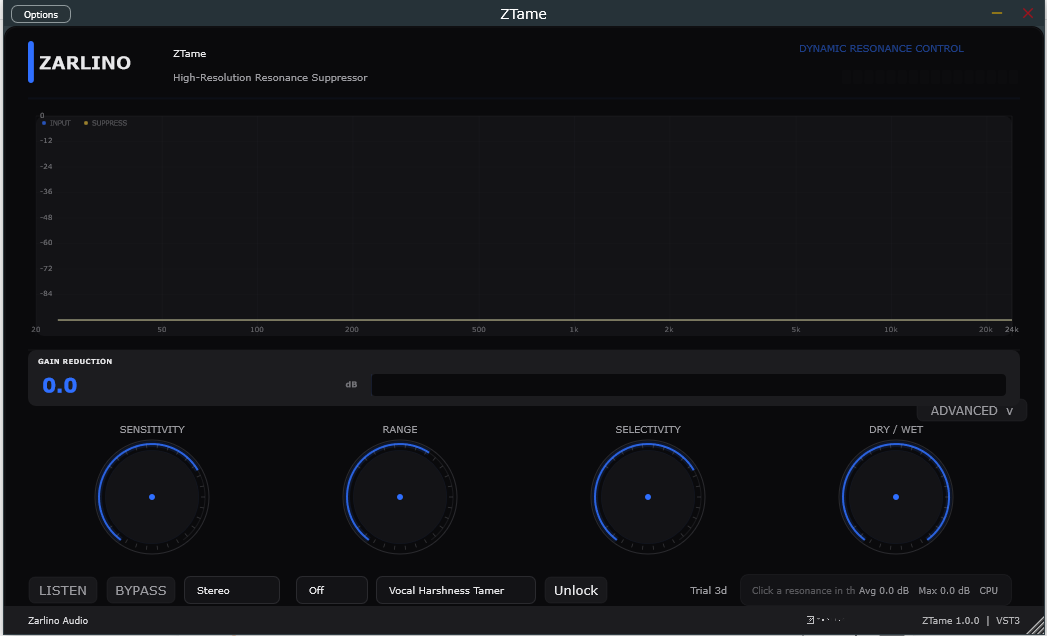
ZTame · $49
Automatically identify and control harsh resonances while preserving the character of the sound.
Explore ZTame →ZScorch ($79) + ZTame ($49) — two tools that complement each other.